A desktop environment for LinuxWayland · Vulkan · Qt Quick

Vela: Modern.Fluid.Sharp.

Vela is an independent desktop for Linux, with its own Wayland compositor and Vulkan renderer, a Qt Quick shell, and a file manager and settings app built to match.

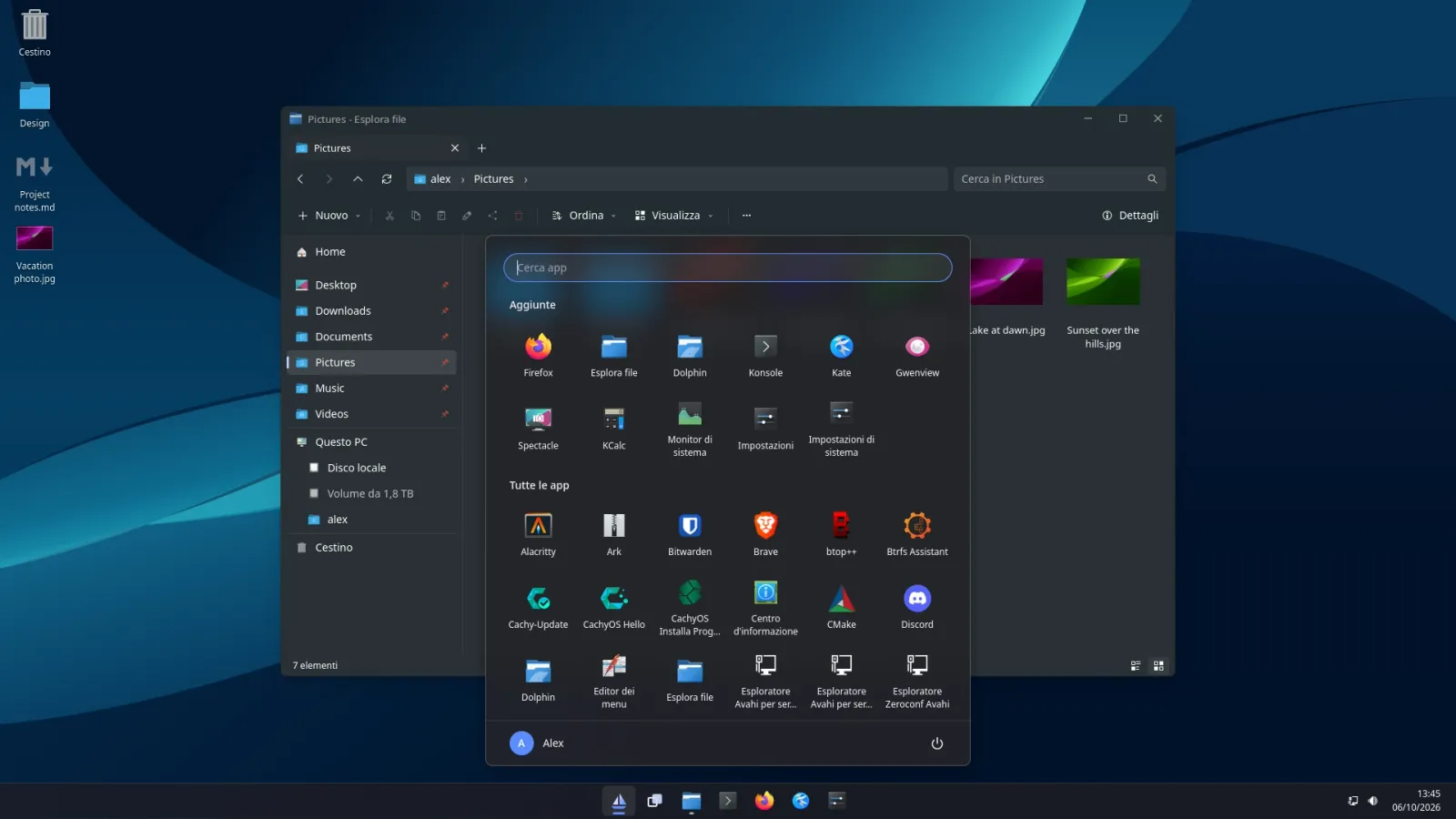
The Vela desktop: the Start menu, with app search and pinned apps, open over the Files window, above a centered taskbar.
Fig. 01Unretouched screenshot: the Start menu over Files. The interface is shown in Italian, one of the two languages Vela ships with.
Compositor
Wayland, own scene graph on wlroots
Renderer
Vulkan 1.4, no GL fallback
Shell
Qt 6 and Qt Quick
License
GPL-3.0-or-later
Status
Alpha, usable every day

One desktop, designed as a whole.

A coherent shell, polished motion, snap layouts, virtual desktops, quick settings, notifications and a file manager — built together, rather than gathered from unrelated utilities.

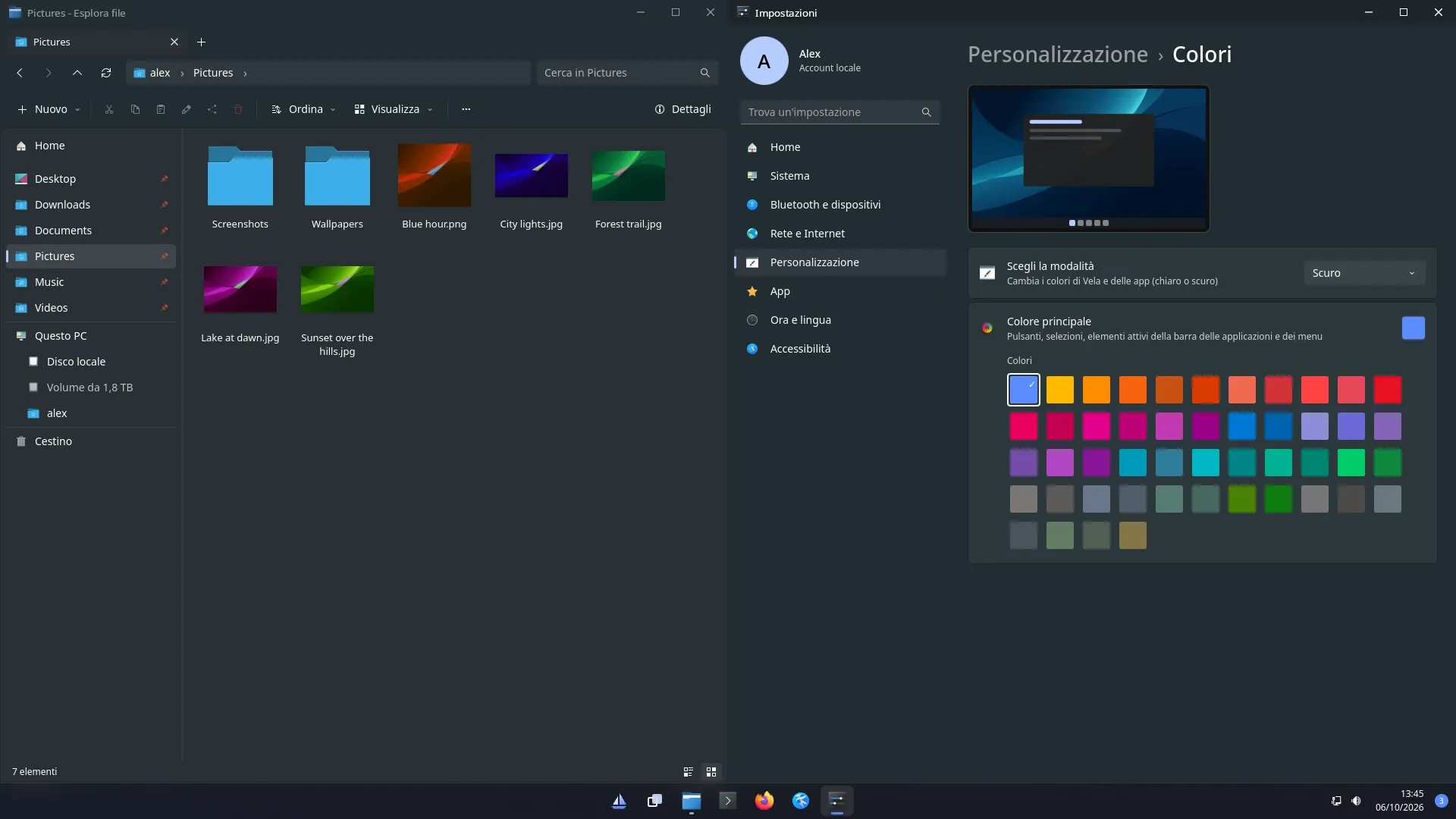
Files and Settings snapped side by side, each taking half of the screen.
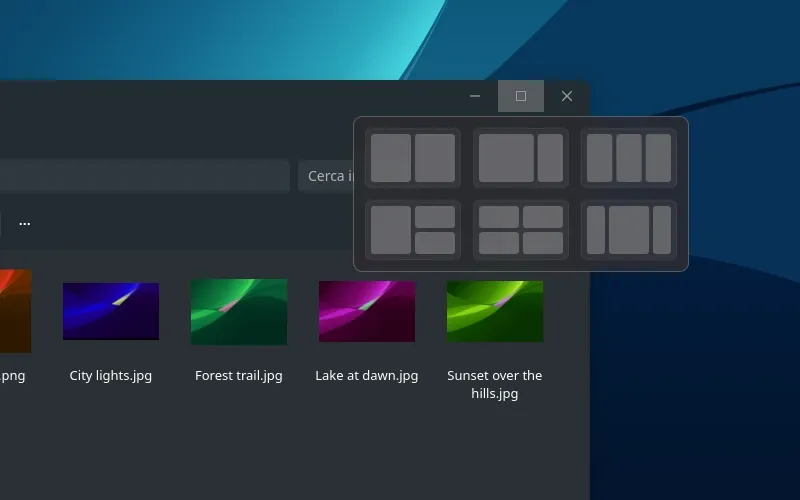
Close-up of the snap layouts flyout under a window's maximize button, offering six arrangements.
Detail The flyout appears over the maximize button.

Snap

Halves, quarters, and six layouts.

Drag a window to an edge or a corner, use Super + arrows, or hover the maximize button — Super Z from the keyboard. Snap Assist offers your other windows for the empty space, and windows arranged together form a snap group that the taskbar shows and restores as one.
Task View

Every window, every desktop, at a glance.

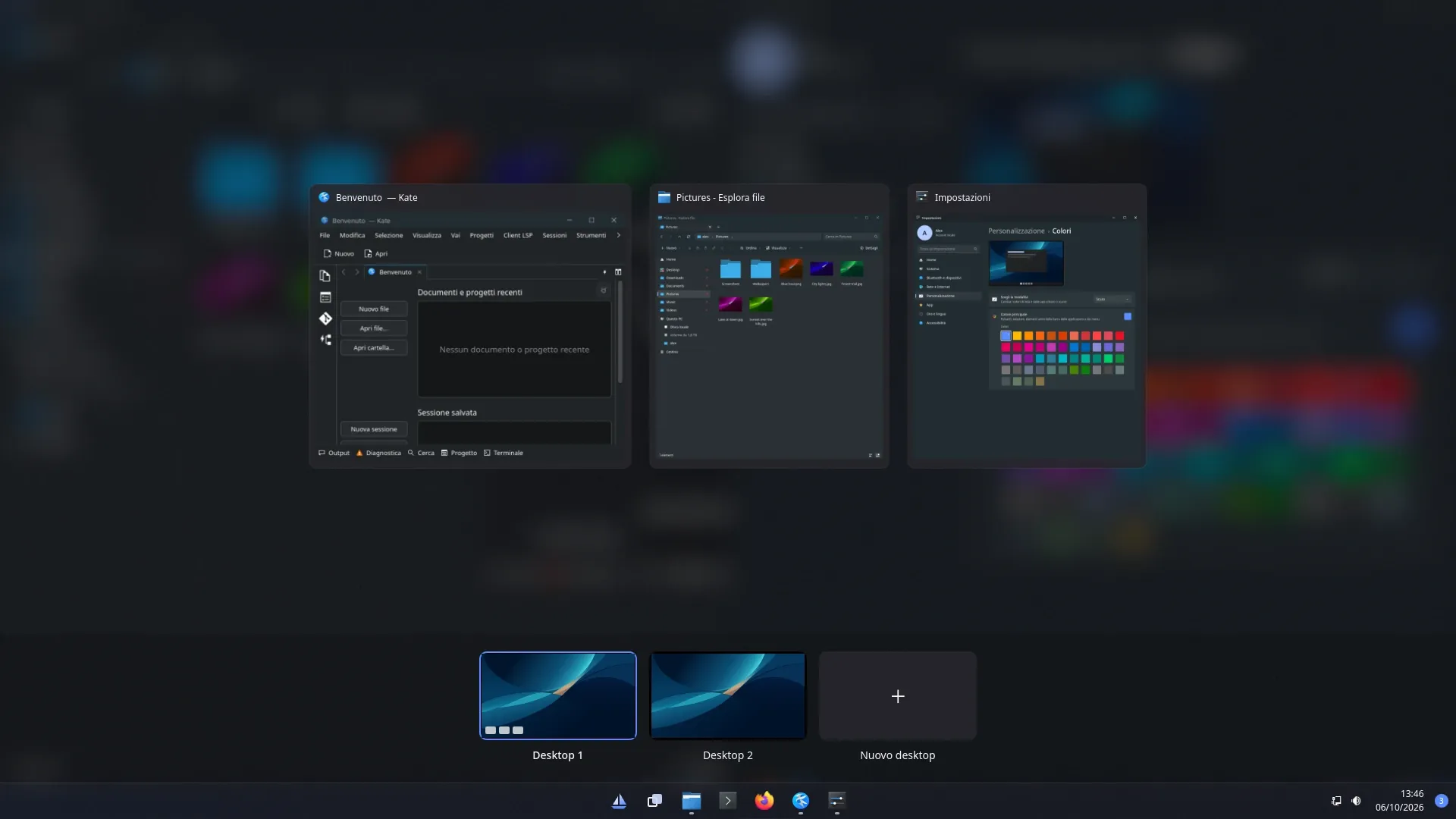
Super Tab shows live previews of your windows and your virtual desktops. Drag windows between desktops, rename and reorder them, and move between them with Super Ctrl ← → and a sliding animation. Your desktops are remembered across sessions.

Task View: previews of three windows above a row of two virtual desktops and a button to add a new one.
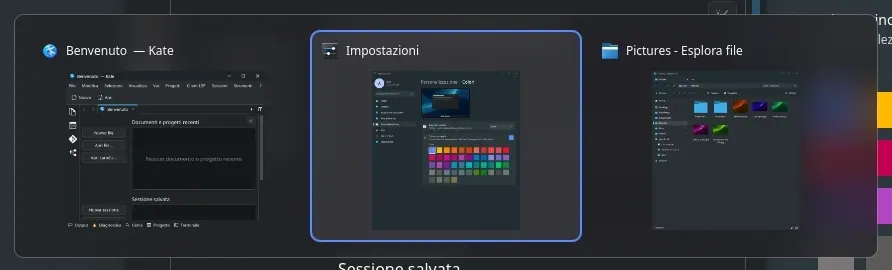
The Alt+Tab switcher with live previews of three windows, the middle one selected.
Alt+Tab with live previews, minimized windows included. A quick press simply switches, without showing the panel.

Light and dark

Switched instantly, for the shell and for apps.

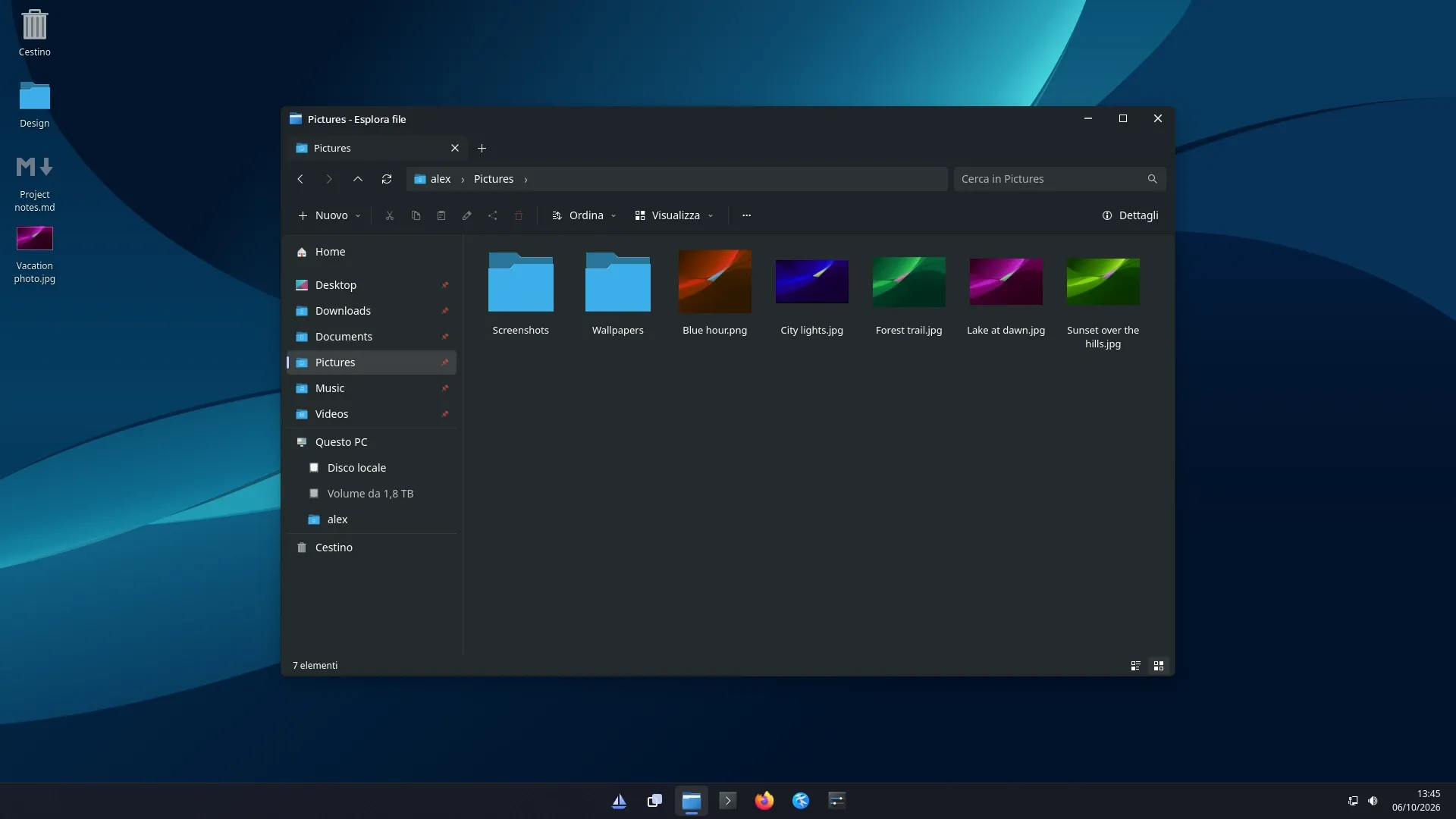
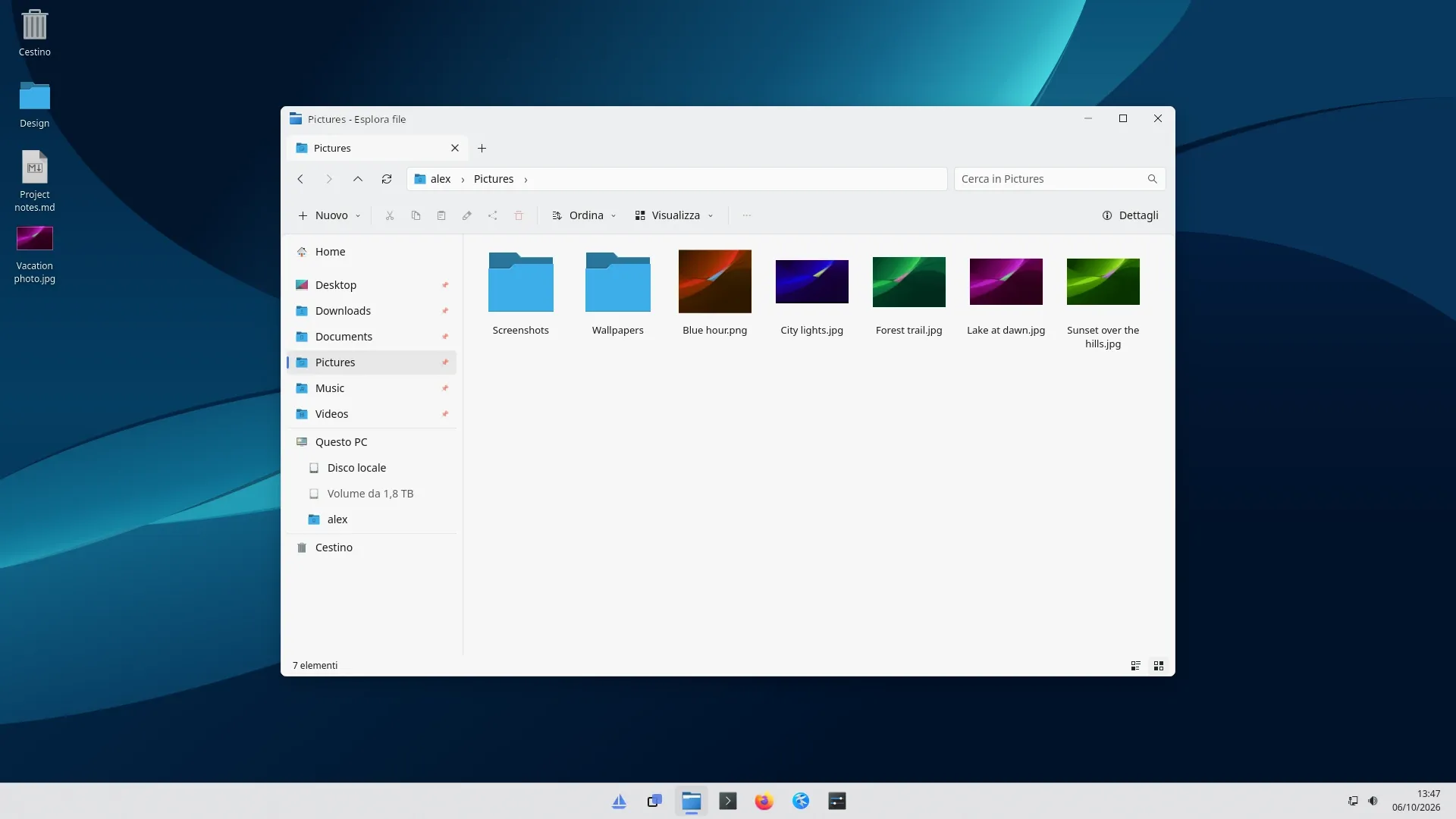
One coordinated accent palette, applied to KDE and GTK apps too. Shown here: Files, Vela’s own file manager — tabs, breadcrumbs, a preview pane, and a first frame in about 100 ms.Drag across the image to compare.

Files in dark mode, showing the Pictures folder, over the Vela desktop.
The same Files window in light mode, with a light taskbar.
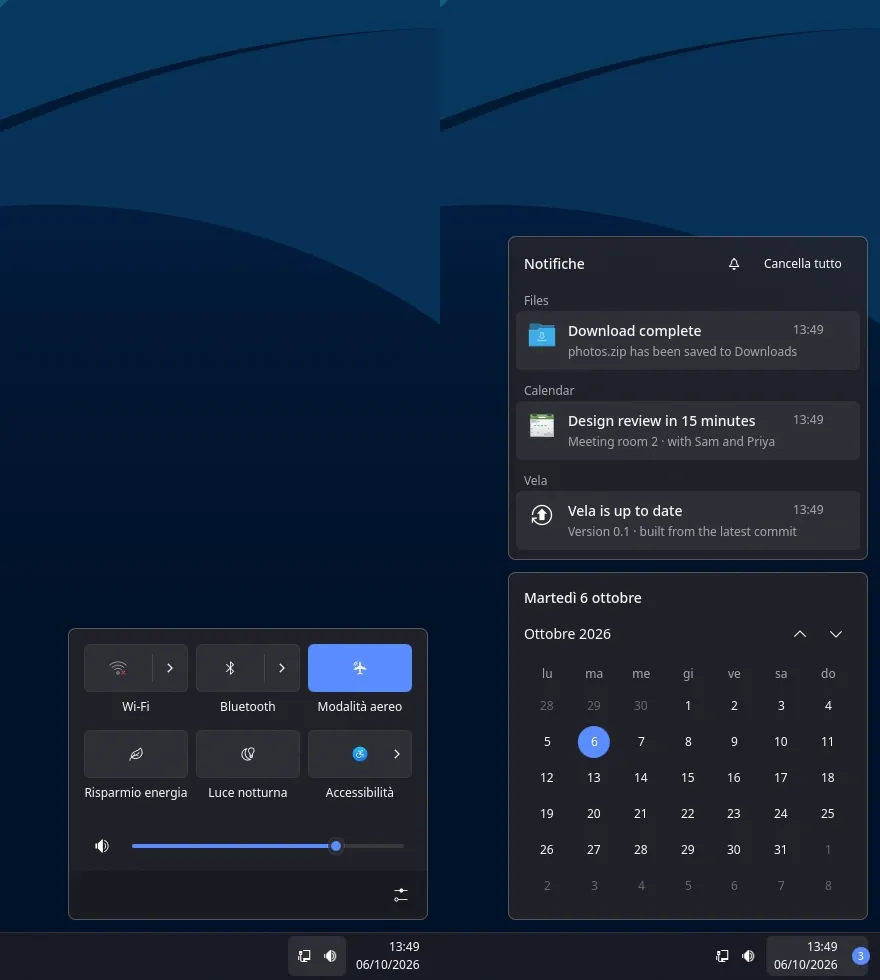
Quick settings with Wi-Fi, Bluetooth, airplane mode and volume, next to the notification center with three notifications and a calendar.

The shell

Quick to reach, and out of the way.

Panels and menus sit on a live acrylic blur drawn by the compositor. The Start menu appears on the next frame after the key, context menus on the next frame after the click.

  1. Quick settingsSuperA

    Wi-Fi, Bluetooth, power mode, Night light, brightness, and a sound page for each app’s volume and output.

  2. Notification centerSuperN

    Notifications with actions, a calendar, and Do Not Disturb.

  3. Clipboard historySuperV

    Text and images, with pinned items that survive a reboot.

  4. Snipping toolSuperShiftS

    A rectangle, a window or the full screen, to the clipboard and to Pictures.

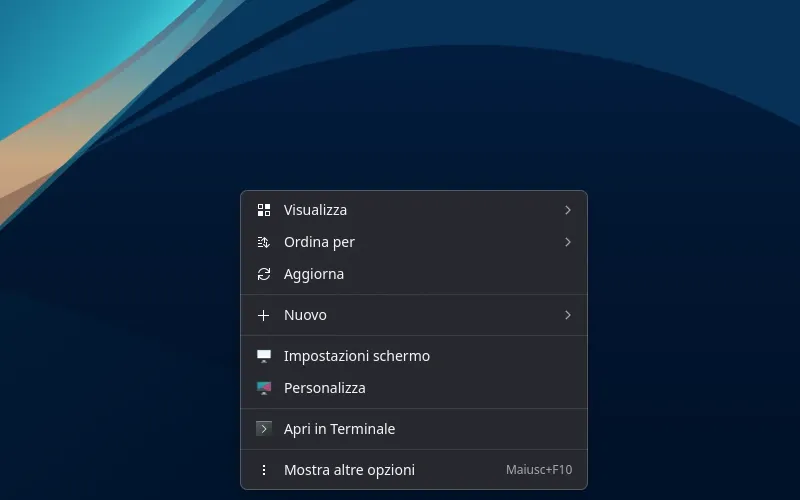
The desktop context menu, with View, Sort by, Refresh, New, display settings, Personalize and Open in Terminal.
Context menus with a compact primary view; KDE service menus wait under “Show more options”.
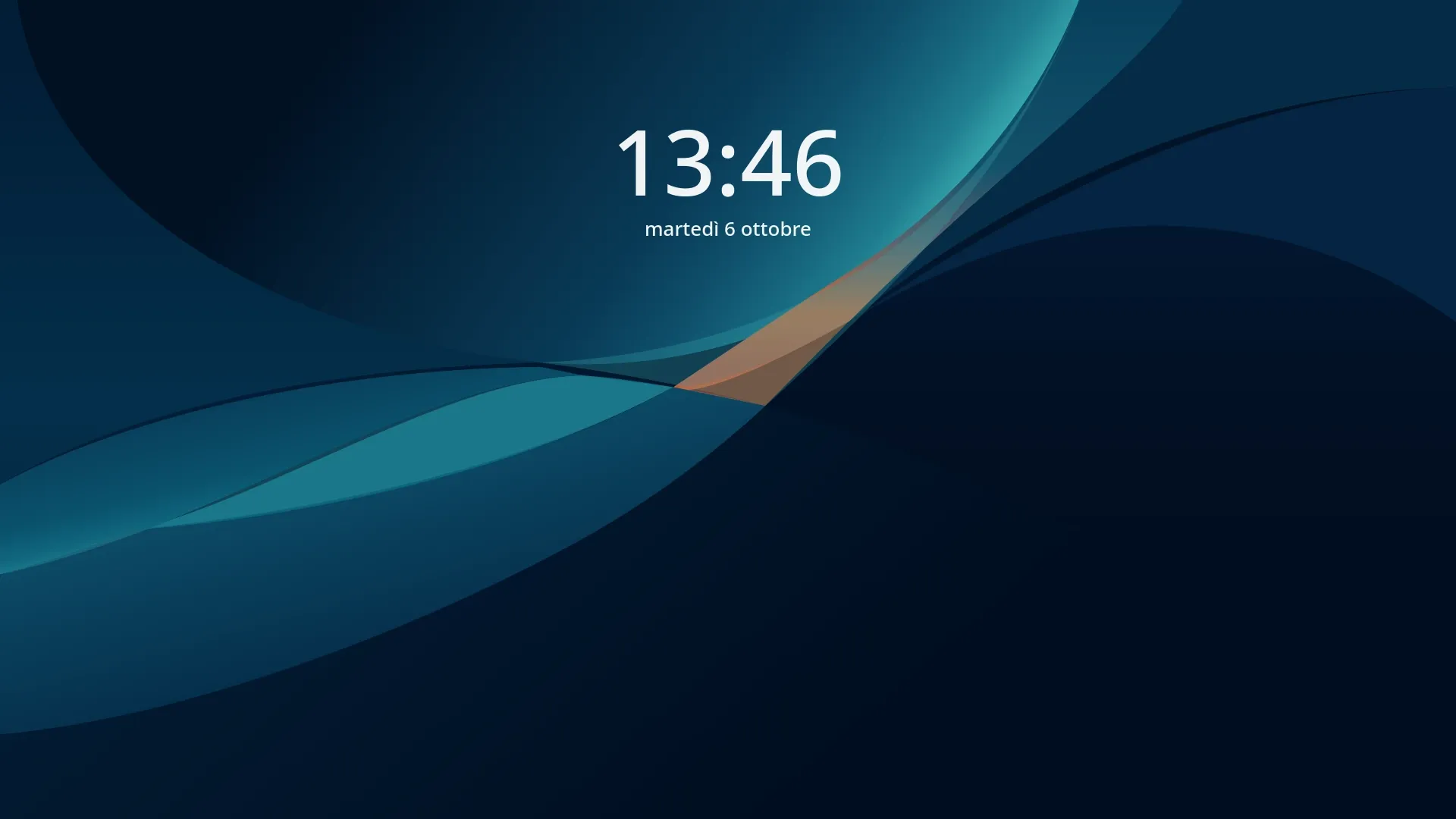
The Vela lock screen: the time and date over the default wallpaper.

A session you can rely on

A crash is not the end of the session.

A tiny supervisor holds the Wayland socket. If the compositor crashes, a new one starts on the same socket, and Qt and KDE apps reconnect and reappear. If the screen was locked, Vela comes back locked: the lock screen is built on ext-session-lock, so a crash never reveals the desktop.

Efficiency through architecture, not austerity.

Use hardware when it improves the experience. Avoid overhead when it doesn’t. Vela does not remove motion or effects to win a memory chart — its savings come from doing less unnecessary work.

Damage tracking skips what did not change. Direct scanout bypasses compositing when it can. With nothing changing on screen, nothing is redrawn and the GPU sleeps.

  1. 3.1

    Modern

    A shell, a file manager and a settings app designed as one desktop, on a compositor and renderer written for them. Vela targets current hardware and modern displays on purpose.

    It asks for a GPU with Vulkan 1.4, and in return the compositor draws live acrylic blur behind the shell, and rounded corners and soft shadows around windows — sharp at every scale.

    1. AppsFiles · Settings
    2. ShellQt Quick, blurred panels
    3. CompositorScene graph · damage · frame clock
    4. RendererVulkan 1.4
    5. DisplayDirect scanout · VRR · tearing control
    One stack, designed together
  2. 3.2

    Fluid

    Animations advance on the monitor’s real vblanks, never on arbitrary timers: at 180 Hz they take 180 steps per second. Each output keeps its own clock, predicts when the next frame will reach the screen, and starts drawing as late as it safely can.

    A slow app can’t hold the screen back: until its GPU finishes, the screen keeps its previous frame, and the cursor and every other window stay on the vblank.

    60 Hz
    180 Hz
    drawing, as late as safely possible vblank animation step
    The same 100 ms at two refresh rates: one animation step per vblank
    1.1–1.9 ms
    from drawing to light at every refresh rate from 60 to 360 Hz, against a whole frame period without late latching
    0 missed vblanks
    with an app whose GPU finishes 150 ms late — down from 47
  3. Copied 1:1 at 125%: every line stays one pixel.

    Resampled to 125%: lines smear into grays.

    Alternating one-pixel lines, magnified. Right: bilinear filtering, computed
    3.3

    Sharp

    Fractional scaling is pixel-exact when an app renders at the screen’s scale: its buffer is copied 1:1 with no filtering, even at 125% or 175%. Window edges are rounded in physical pixels, so two windows snapped side by side never gain a gap or an overlap.

    An automated test checks it bit for bit after opening, snapping, maximizing and restoring a window. A single differing pixel fails the test.

It owns the whole pipeline

From the moment an app commits a surface to the moment the pixel lights up: its own scene graph and Vulkan renderer on top of wlroots, with no wlr_scene and no wlroots renderer.Read the renderer design

  1. input
  2. state
  3. predicted frame
  4. render as late as possible
  5. presentation feedback
  6. correct the model

Measured, not claimed

17MiB
Compositor memory at idle (PSS)
0.1%
Compositor CPU at idle, 3–7 wakeups per second
104ms
Files, cold start to first frame (median of 5)
0.05–0.13ms
GPU time per frame for live blur as the Start menu opens

All figures from Vela’s primary development system — Ryzen 9 9950X, Radeon RX 9070 XT, CachyOS, Mesa/RADV. Idle figures are sampled over 30 seconds by scripts/measure.sh; late-latching figures come from the headless backend running vkcube. Other hardware will differ.

Built in the open.

Vela is free software under the GPL, version 3 or later. It is young, it moves fast, and all of it — compositor, renderer, shell and apps — is developed in public.

Alpha

You can already pick Vela at the login screen and use it every day: compositor, shell, file manager, settings and lock screen. The GPU test suites pass in full on the primary development machine, but some hardware-specific paths still rely on manual verification. Expect rough edges, and expect things to change.

RequiresA GPU with Vulkan 1.4 — AMD or Intel with Mesa 25.0 or newer, or NVIDIA with the proprietary driver 570 or newer, or NVK.

  1. 01

    Try it

    On Arch Linux, CachyOS and EndeavourOS, Vela installs as a proper vela-git package, updated with vela-update. Other distributions can build from source.

    $ git clone https://github.com/vela-desktop/vela.git
    $ cd vela/packaging/arch
    $ VELA_GIT_URL=file://$PWD/../.. makepkg -si
    Installation guide
  2. 02

    Follow along

    Watch the repository for changes, read the journal for the reasoning behind them, or subscribe to the feed.

  3. 03

    Contribute

    Issues and ideas are welcome. Before larger changes, open an issue to talk about it, and sign off your commits under the Developer Certificate of Origin. If something breaks, vela-report builds a diagnostic ZIP with only the evidence you choose — and uploads nothing.

The sourcegithub.com/vela-desktop/vela